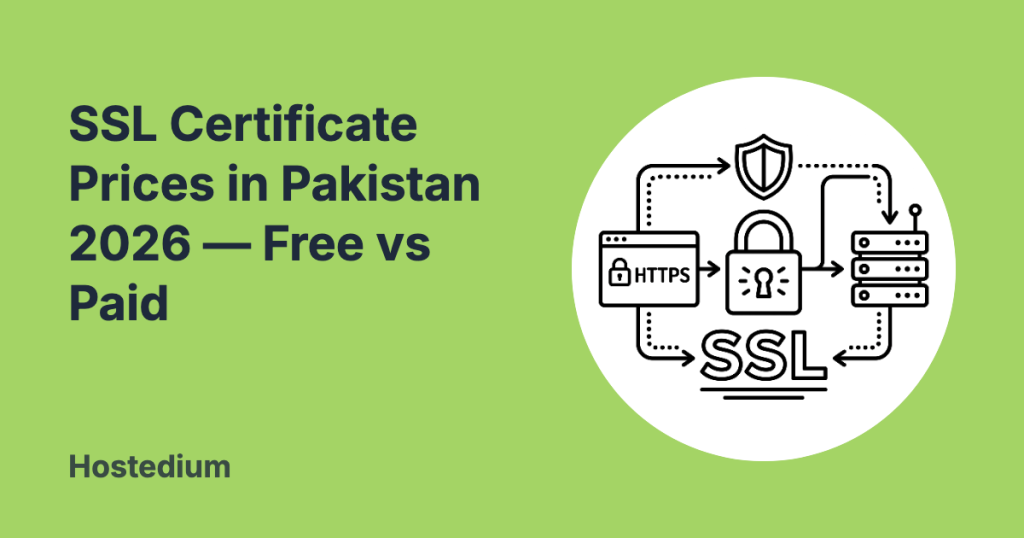

Understanding the exact SSL certificate price in Pakistan is essential for any business launching a secure website today. Prices range from completely free to over PKR 75,000 per year, depending largely on the validation level, the issuing brand, and the number of domains covered. Securing an ssl certificate in Pakistan ensures your website encrypts visitor data, protects sensitive login credentials, and displays the trusted padlock icon in modern browsers.
Free vs Paid SSL Certificates: What Is the Difference?
The underlying encryption strength of a free SSL certificate is identical to a paid one. Both use industry-standard 256-bit encryption and 2048-bit RSA keys to secure data in transit between your server and the visitor’s browser. The difference in price comes down to authentication depth, warranties, and specialized use cases.
Free certificates, such as those issued by Let’s Encrypt, only verify domain ownership. Automated systems check if the person requesting the certificate controls the domain. These are perfect for blogs, portfolios, and basic informational websites. At Hostedium, we include automated free SSL provisioning by default on all our plans, meaning you do not have to worry about manual renewals or hidden security fees.
Paid certificates involve human intervention. Certificate Authorities (CAs) like Sectigo, DigiCert, or GlobalSign will manually verify your business registration documents, physical address, and phone number before issuing an Organization Validation (OV) or Extended Validation (EV) certificate. This manual vetting process is the primary reason for the higher costs associated with premium certificates.
Average SSL Pricing Breakdown in Pakistan
Because most Certificate Authorities charge in US Dollars, the exact cost in Pakistani Rupees fluctuates based on exchange rates and bank conversion fees. Below is an estimated yearly breakdown of what you can expect to pay for various certificate tiers.
| Certificate Type | Validation Level | Estimated Yearly Price (PKR) | Best Use Case |
|---|---|---|---|
| Domain Validated (DV) | Low (Automated) | Free – 5,000 | Blogs, Personal Sites, Small Business |
| Organization Validated (OV) | Medium (Manual) | 12,000 – 25,000 | Corporate Websites, Non-Profits |
| Extended Validated (EV) | High (Strict Manual) | 35,000 – 75,000+ | Banking, Large E-commerce, Financial Apps |
| Wildcard (DV or OV) | Variable | 20,000 – 60,000+ | Sites with Multiple Subdomains |
Deep Dive: Which Certificate Should You Buy?
Choosing the right tier depends entirely on your business model and risk profile. As detailed in Cloudflare’s guide on SSL certificate types, the underlying encryption technology remains identical across all certificates, but the vetting process is what establishes higher consumer trust. Let us examine the specific categories.
Domain Validated (DV) Certificates
DV certificates are the fastest to issue, typically taking only a few minutes. They require no paperwork. If you are operating a standard informational site, there is rarely a need to pay for a DV certificate. You might wonder how to get a free SSL certificate in Pakistan if your current setup lacks one. The easiest method is utilizing cPanel’s AutoSSL feature, which automatically generates and renews DV certificates without any manual intervention.
Organization Validated (OV) Certificates
OV certificates require the issuing authority to verify your actual business existence. They will check government databases to ensure your company is legally registered in Pakistan. When users click the padlock icon in their browser, they will see your verified company name. This provides a moderate trust boost for mid-sized corporate websites and B2B platforms.
Extended Validated (EV) Certificates
EV certificates represent the highest tier of trust and carry the heaviest price tags. The vetting process is rigorous, often requiring legal opinion letters, direct phone calls to human resources, and extensive background checks. Financial institutions, payment gateways, and large e-commerce stores in Pakistan use EV certificates to defend against phishing attacks. Users are trained to look for verified company details before entering credit card information.
Wildcard and Multi-Domain Certificates
If your website relies on complex architecture, a standard single-domain certificate will not suffice. A Wildcard certificate secures your primary domain and an unlimited number of first-level subdomains. For example, a single Wildcard certificate protects your shop, blog, and client portals simultaneously. While the upfront cost is higher, it is significantly cheaper than buying individual certificates for twenty different subdomains.
Hidden Costs and Installation Fees
The sticker price of the certificate is not always the final cost. Many local IT agencies charge separate fees for generating the Certificate Signing Request (CSR), installing the files on the server, and configuring forced HTTPS redirects. These administrative fees can sometimes exceed the cost of the certificate itself.
Furthermore, older hosting environments required a dedicated IP address to install a private SSL certificate. Thanks to modern Server Name Indication (SNI) technology, this is no longer a strict requirement, but some legacy providers still enforce it, adding another monthly fee to your bill. Finding web hosting with free ssl integrated at the server level bypasses these hidden configuration charges completely, as the host handles the deployment seamlessly.
Crucial Questions About Securing Your Website in Pakistan
Does a free SSL certificate provide the same security as a paid one?
Yes, free certificates use the exact same 256-bit encryption standards as their paid counterparts. The difference lies entirely in the level of identity verification performed by the issuing authority and the presence of financial warranties against data breaches.
Are SSL prices in Pakistan affected by dollar exchange rates?
Yes, because the major Certificate Authorities are global entities that bill in US Dollars, the final price in Pakistani Rupees is directly tied to the current exchange rate. Additionally, local banks apply international transaction fees and currency conversion margins, which slightly increases the final cost.
Can I upgrade from a free DV certificate to a paid EV certificate later?
You can upgrade your security posture at any time. The process involves generating a new Certificate Signing Request (CSR) from your server, purchasing the EV certificate, passing the manual business validation process, and then installing the new files to replace the existing free certificate.
What happens to my website if I do not pay my SSL renewal fee?
If your paid certificate expires, browsers will immediately block access to your website, displaying a prominent red warning screen that states your connection is not private. This severely damages user trust and abruptly halts any e-commerce transactions until a new certificate is installed or the old one is renewed.
Do I need a separate SSL certificate for each subdomain?
If you use standard single-domain certificates, you will need a separate one for each subdomain. However, purchasing a Wildcard certificate allows you to secure your main domain and unlimited first-level subdomains under a single file and a single yearly fee, making it highly cost-effective for larger architectures.
How much does a Wildcard SSL certificate cost in Pakistan?
Pricing for a Wildcard certificate generally starts around PKR 20,000 per year and can scale upwards of PKR 60,000 depending on the issuing brand and whether you choose a DV or OV validation level. The investment is justified if you manage more than three active subdomains.
Is installation included in the SSL certificate price?
When purchasing directly from a Certificate Authority, the price only covers the issuance of the cryptographic files. Installation is typically your responsibility. If you lack server administration skills, you may need to hire a developer or ask your hosting provider, which could incur additional labor charges.