
Which SSL certificate should I choose for my ecommerce store?
For most small and medium ecommerce sites, Organization Validation (OV) is the recommended baseline because it confirms a verified business identity while keeping cost and issuance time reasonable.
For larger merchants, high-risk verticals, or sites handling high-value transactions, Extended Validation (EV) adds the strongest identity signals and can reduce buyer hesitation. According to SSL.com and DigiCert, OV or EV are generally recommended for transactional sites; SSL2Buy emphasizes that all three types use the same encryption strength.
Do DV, OV, and EV provide different encryption strength?
No — DV, OV, and EV certificates all enable the same HTTPS encryption algorithms and security levels. The core difference is in identity vetting and trust signals rather than cryptographic strength.
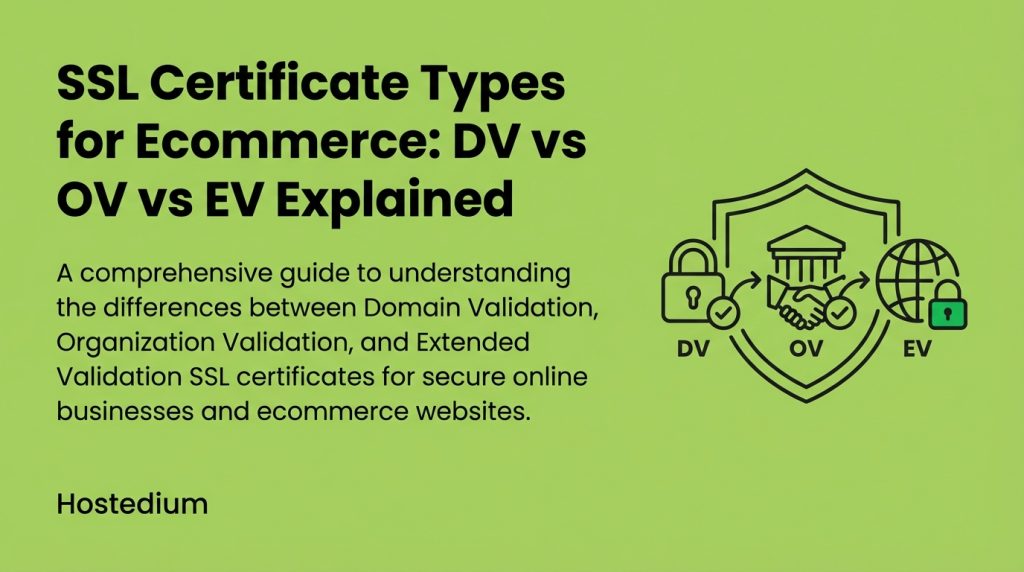
What are the core differences between DV, OV, and EV?
The table below summarizes verification, trust, issuance time, cost, and typical use cases to help you choose.
| Feature | DV (Domain Validation) | OV (Organization Validation) | EV (Extended Validation) |
|---|---|---|---|
| What is verified | Domain control | Domain + legal business details | Domain + full legal & operational vetting |
| Trust level | Basic | Intermediate / business-grade | Highest / premium trust |
| Encryption strength | Same | Same | Same |
| Issuance time | Minutes | 1–3 business days | 5–15 business days |
| Typical cost | Lowest | Mid-range | Highest |
| Who can get it | Anyone with domain control | Registered organizations | Registered organizations |
| Browser indicators | Padlock + HTTPS | Padlock + org name in cert details | Padlock + org name in cert details |
Is EV worth the extra cost for ecommerce?
EV gives the strongest identity verification and can help reduce cart abandonment where buyer trust is a major conversion factor.
Consider EV if you operate in finance, healthcare, high-value retail, or if your brand faces frequent phishing attempts.
- Best for banks, payment processors, and high-risk merchants 🛡️
- Can improve user confidence during checkout 💳
- Higher cost and longer issuance time compared with OV and DV ⏳
How long does issuance take and what will it cost?
DV certificates are issued in minutes and are the cheapest option. OV usually takes 1–3 business days and costs more than DV. EV often takes 5–15 business days and is the most expensive due to stricter vetting.
Factor in time for document preparation and any phone or registration checks when planning a launch timeline.
What practical checklist should I use to pick between DV, OV, and EV?
Use this short checklist to match certificate type to your business priorities.
- Choose OV if you want verified business identity without EV overhead ✅
- Choose EV if you need the highest assurance and face reputation or regulatory risk 🔒
- Use DV only for testing, early-stage sites, or when budget/time is the main constraint ⚡
How do I test and validate my SSL after installation?
Run quick checks to ensure correct installation and trust visibility.
- Verify HTTPS and padlock in browser
- Inspect certificate details for organization name (OV/EV)
- Use an SSL checker to confirm chain and protocol support
- Test site pages with mixed-content scanner
Troubleshooting common certificate issues
Payment pages or mixed content errors are the most common post-install problems and usually stem from insecure resource links or an incomplete chain.
- Check for mixed HTTP assets on secure pages
- Ensure intermediate certificates are installed
- Confirm domain names match certificate SANs
FAQs
Does a DV certificate protect customer data?
Yes. DV provides the same encryption as OV and EV, so data in transit is encrypted. The difference lies in business identity verification, not cryptography.
Will EV show a green address bar in browsers?
No. The old green bar UI has been deprecated in modern browsers, but EV still includes verified organization details visible in the certificate info.
Can attackers use DV certificates for phishing?
Yes. Because DV only proves domain control, attackers can obtain DV certs for malicious domains; this is why OV or EV are recommended for ecommerce that depends on brand trust.
How often should I renew or revalidate my certificate?
Renew before expiration and revalidate according to CA requirements; OV and EV may require re-verification of business details periodically.
Wrapping up
For most transactional stores, OV provides a strong balance of trust, cost, and speed, while EV suits high-risk or high-value operations; DV is fine for early testing but should be upgraded for production. If you share your platform and store size, I can recommend specific OV/EV options and configuration tips.